As you already know, a business proposal is a written document that has one purpose and that is to gain the trust of your potential client.
When looking for a business offer, it is important to be prepared and you will do it best with a good, interesting, and unique business proposal.
So, it is important for your proposal to have all the important details and to attract interested clients.
There are many good ideas on how to make this document as well and quickly as possible, and we have singled out a few to help you and your agency stand out.
Let’s check them out!
1. Customize templates and save time
Using ready-made templates speeds up the whole process of writing a proposal and allows more free time for some other tasks.
As the work in the agency is exhausting and complex, you need to minimize certain segments of proposal writing and at the same time get an effective proposal.
The best way to do that is by customizing templates exactly as it suits you and as it is best for a particular client.
By using branding design proposal templates, you manage to directly connect the client with your brand as well as give the overall professional impression.
Business proposal tools such as Prospero enable exactly that and more.
It allows you to add your brand’s logo, use different images, videos, tables, and charts. You can also make it more detailed by changing the font size, updating graphics, and changing colours.
In the picture below, we can see just some of the Prospero’s templates.
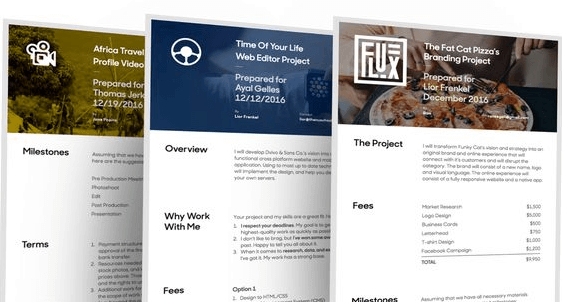
This saves you a lot of time, it’s easy, and at the same time helps you win more projects.
2. Create an outline for your proposal
Your proposal should be a kind of guide for your clients just like the one created by SEO Glasgow, so you need to include a certain structure.
Step by step, include in your proposal all the important segments to make the whole document more clear and purposeful.
Proposal outline that will grow your agency sales should cover the following steps:
-
Include a strong introduction
In a few lines, say something about yourself and why are you interested in this particular job opportunity. You can also add what makes you a better option than others, what you can do for the project.
-
What is your client’s problem
Explain briefly how you see the client’s problem. It is important to show that you empathize with your client and that you understand the task ahead of you.
-
How can you solve it
Of course, the most important thing is to show them what the solutions to their problem are. Be specific and relevant, and your professionalism will be reflected in the fact that you will answer all the client’s questions.
-
Provide case studies
By including your agency’s services and testimonials, you foster a good relationship between you and the client by building trust. Case studies are proof of your competence and previous success. These are helpful because they act as a third-party endorsement of your brand.
-
Include fees and milestones
It is important to first be sure that your price matches the client’s financial capabilities. After that, be specific about the parts of the job and their prices but try not to seem too greedy because the relationship with the client is important for further potential agreements.
Create a fee summary for both shorter projects and for longer ones that include milestone payments.
-
Explain the next steps
When the client decides to collaborate with you, you must clearly show him what the next steps are in order to finalize the whole process. These steps include your contact information so that client can get in touch and accept your proposal.
In addition to all these steps, it is important to set a deadline for the whole project or parts of the project, depending on how you agree.
The outline must be summarized exactly enough to inform the client about the essential items.
3. Follow-up
When you have finished writing the proposal and sent it, it is advisable to check in with your client.
They may have some doubts or additional questions after reading your proposal, so it’s important to do your best to be at your client’s service.
Use tools with which you can automatically receive notifications when a client opens your proposal, and you can also call him after a certain period of time which will only show how committed you are.
You can also use follow-up e-mails to maintain the conversation.
4. Work with your team members
If you work in an agency, working with team members is desirable and sometimes even necessary.
You can share your work with them and include them in the proposal itself.
Collaboration is often fruitful so it always represents an additional benefit and a good idea to increase the chances of getting more sales.
Maybe someone else will be able to notice something you don’t, so it is a good option to have more perspectives and make the whole process easier for yourself by sharing the work, too.
5. Add a clear Call To Action (CTA)
CTAs are especially useful to capture the client’s attention but also to facilitate its action.
It is best to include it at the end of your proposal where it will not disturb the whole concept and yet it will be visible enough.
These buttons show the next steps your client needs to take to get everything running.
These can be CTAs like “Close”, “Submit Signature”, or the most effective “Accept Proposal” as done in the example below:
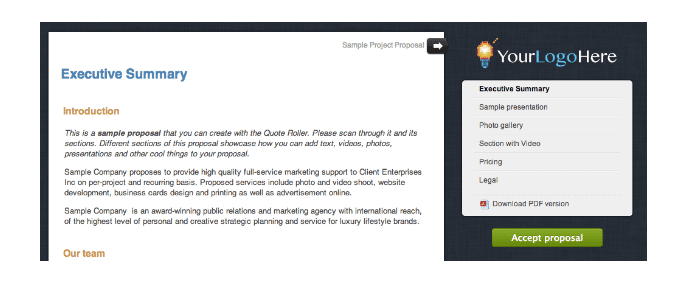
Source: Quoteroller
This great detail separates you from increasing sales with just one click.
6. Don’t forget to proofread
Don’t be fooled into thinking that only content is essential to a quality proposal. It is equally important that you write it correctly.
So, before you submit it, the proposal must be grammatically correct and free of typos.
Don’t let this banality make the client think you are unprofessional and that he doesn’t need your services.
Make sure you and your agency team read your business proposal several times to review everything and put the proposal into circulation.
You can use different tools or any better type of online software for writing error-free content.
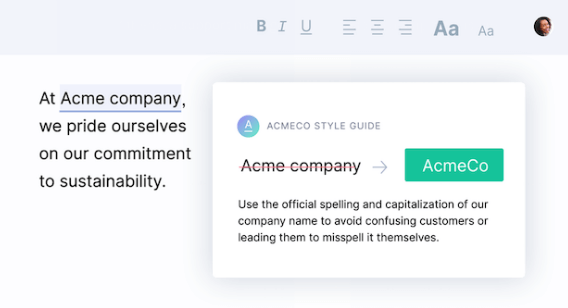
Source: Grammarly
Pay attention to all kinds of mistakes, spelling, grammatical errors, or any misleading parts and fix everything before the client sees it.
The Bottom Line
Writing business proposals can also be an interesting process, especially because you can make it significantly easier and faster.
By using a variety of ideas and tricks, you can increase the chances of you and your agency creating as large a customer base as possible while you manage multiple projects.
The business proposal must be concise, clear, but must also contain all the most important information and have some order.
Design is also important and so take advantage of business proposal templates and customize them.
If you want to make your proposals stand out then try Prospero with its amazing features.
Follow these amazing business proposal ideas that we have singled out for you and find yourself at the very top!